My Shearwater Perdix 2 computes a number called GF99 every ten seconds of every dive: the leading tissue’s supersaturation as a percentage of its Bühlmann M-value at my current depth. In plainer words, it says how close my dissolved gas load is to the decompression model’s limit, where 100 means I’m standing on the line. It’s one of the most interesting numbers a dive computer produces, a live readout of how loaded I actually am, and Shearwater Cloud plots it. But the XML export, the thing you’d reach for to get your data out, doesn’t contain it, and neither does the CSV. Same for the deco ceiling, the per-sample battery voltage, and the @+5 prediction. The app is clearly reading them from somewhere.
So I went looking. This post is about what I found: Shearwater’s Petrel Native Format, the 32-byte record stream every Petrel-family computer logs internally, and the four bytes in it I first mapped by experiment and only later confirmed against Shearwater’s own code. The decoder ships in bottomtime, the dive-log store I wrote for my two-computer logging habit (pip install bottomtime).
Where the real log lives
Shearwater Cloud’s desktop app has three export options. XML and CSV are lossy renderings. The third, “Export Database”, writes a SQLite file called dive_data.db, and that one contains the real log. Inside there’s a log_data table with a BLOB column, one blob per dive, tagged sw-pnf. The blob layout is a 4-byte little-endian length followed by a gzip stream:
expected = struct.unpack_from("<I", blob, 0)[0]
data = gzip.decompress(blob[4:])
assert len(data) == expected
assert len(data) % 32 == 0
For my dive #202 (101.5 m at Drop Off dive site Tulamben, 102 minutes runtime), the blob is 16,388 bytes, the prefix promises 26,496, and gzip delivers it: 828 records of 32 bytes. The whole dive which is one record every 10 seconds plus bookkeeping, is compressed smaller than a photo on your phone. Wow \(*o*)/!
Byte 0 of each record is its type. In that dive the stream looks like this:
| type | meaning | count in dive #202 |
|---|---|---|
0x01 | dive sample | 616 |
0x10-0x19 | opening (config) records | 1 each |
0x20-0x29 | closing records | 1 each |
0x30 | info event | 7 |
0x00 | all-zero padding, skipped | 4 |
0xFF | final record (serial, model, firmware) | 1 |
0x51, 0x70-0x75, 0x80-0x87, 0xA0, 0xA1 | no idea (yet) | 180 |
The opening records carry the dive’s configuration: the ten programmed gases, gradient factor settings, units, water density, atmospheric pressure, sample interval. The closing records mirror them with end-of-dive state.
The last row is the one I care about. Every record type the decoder doesn’t understand is stored verbatim in the database, per dive, in stream order. Nothing is dropped just because I can’t read it today.
Standing on libdivecomputer
Luckily, I didn’t have to start from scratch. The open-source libdivecomputer project has supported Petrel-family computers for years, and its shearwater_predator_parser.c handles PNF explicitly. A comment in the parser notes that relative to the legacy Predator format “the samples are simply offset by one”, because PNF prepends the record-type byte, and it documents the sample layout: depth in the first two bytes of a sample, then next stop, TTS, gas fractions, temperature, CNS. Reading that parser is how I knew what the documented bytes were, and how to check my own mapping against them.
That parser is as close to a public spec as PNF gets. Shearwater does write protocol documentation, but hands it only to registered developers through a formal process. Subsurface imports the desktop database by querying its pre-decoded tables and never opens the blob. So for the undocumented bytes, there was nothing left to look up.
Lay the documented offsets over a PNF sample record and 23 of its 32 bytes are accounted for, counting the type byte. The other nine are either padding or they’re the fields the exports omit, and Shearwater Cloud clearly reads something more, because it plots GF99.
Reading the record, byte by byte
Here is the actual record from the deepest sample of dive #202, the moment the gauge read 101.5 m. Hover (or tap) any byte:
The documented bytes check out against what my wrist showed at 101.5 m: 11/63 trimix, TTS 53 minutes, next stop 33 m, CNS 4%, water 25 C. The arithmetic is nothing fancier than big-endian shorts and a divide by ten.
The four bytes I had to find myself
Bytes 18, 24, 25 and 26-27 are the ones libdivecomputer doesn’t read and the exports don’t include. Mapping them was an empirical process where I had to stare at the values across hundreds of dives, form a hypothesis, and try to falsify it.
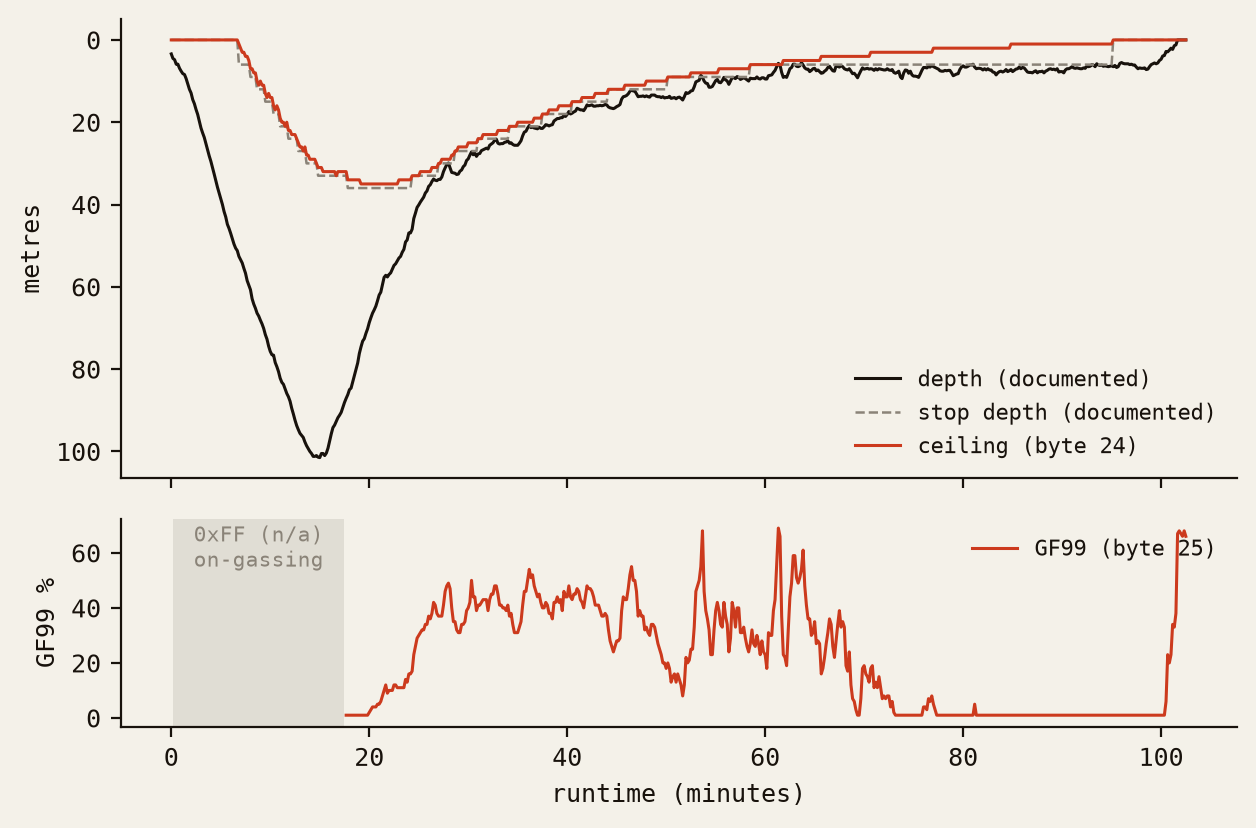
Byte 25 was an interesting light bulb moment. It reads 0xFF early in a dive, wakes up as tissues load, decays during long shallow stops, and spikes right at surfacing. That is exactly how GF99 should behave, and it converges on the EndGF99 value Shearwater Cloud computes for each dive. Byte 24 hugs the depth profile from below during deco, always sitting at or just under the 3 m-quantized stop depth, and zeroes the moment deco clears. That’s the ceiling! Byte 18 matched the XML export’s batteryVoltage times 100 on every sample I checked. Bytes 26-27 tracked TTS but ran ahead of it by a sensible margin, which is the @+5 display field, TTS if I stayed five more minutes.
Here’s dive #202 with the empirical bytes plotted. Ceiling in red riding under the grey quantized stop depth and GF99 waking up at the 17-minute mark once the tissues actually have something to report:
But a curve that behaves right is still circumstantial. Hmm (╭ರ_•́)..
So I wrote a verification suite that cross-checks every decoded channel, per sample, against Shearwater’s own outputs across all 142 dives on this Perdix, and it deserves its own post. Short version: the worst disagreement between my decoder and Shearwater’s XML across every shared sample is 0.0000, and byte 25’s surfacing value agrees with Cloud’s EndGF99 on 142 of 142 dives within one GF point.
Then I read Shearwater’s own code
I could have stopped at the verification suite. Then a Reddit comment pointed out that Shearwater Cloud ships its parser as a .NET assembly, DiveLogParser.dll, and that you can open the class PetrelNativeLogV14Parser in a decompiler and read the format directly. That’s a Windows workflow, and I’m on a Mac, but the macOS build of Shearwater Cloud is a Unity app and it ships the same managed DLL under Shearwater Cloud.app/Contents/Resources/Data/Managed/. It turned out to be real .NET bytecode which I could read.
The byte offsets are stored as named constants right in the assembly metadata, so I didn’t even need a decompiler. dnfile, a pure-Python reader, dumps them straight out. Here is what Shearwater calls the bytes I had mapped by hand:
GF99_OFFSET                = 25
DECOCEILING_OFFSET         = 24
BATTERYVOLTAGE_OFFSET_LSB  = 18
ATPLUSFIVE_1ST_BYTE_OFFSET = 26
Four for four, sweet! And three bytes I’d filed under “no idea” got names in the same table. Byte 11 is BATTERY_PERCENT_REMAINING, which is why it sat in the eighties and nineties and, I checked, never once exceeds 100 across all 32,544 samples. Byte 17 is BATTERYVOLTAGE_OFFSET_MSB: the high byte of a sixteen-bit battery voltage whose low byte is 18, reading zero only because 1.5 volts never needs the high byte. Bytes 30-31 hold surface air consumption. Shearwater’s constant calls it RESPIRATORY_MINUTE_VOLUME but the parse method reads it as SAC and divides by 100. Either way it’s 0xFFFF for me, since I dive without gas integration.
Decompiling the actual parse method with ILSpy caught something the that wasn’t obvious from the constants alone. Bytes 24 and 25 are ceiling and GF99 only when the decompression model uses gradient factors:
if (headerDecoModel == 3) {   // DCIEM
    byte b = logData[offset + 24];
    float frac = logData[offset + 25] / 100f;
    sample.SafeAscentDepth = b - frac;
} else {                      // GF, VPM-B, VPM-B/GFS
    sample.DecoCeiling = logData[offset + 24];
    sample.Gf99 = logData[offset + 25];
}
On a DCIEM dive those two bytes are a safe-ascent depth instead, and my decoder, which reads byte 25 as GF99 no matter what, would mis-decode it. All 142 of my dives run gradient factors, so the bug has never fired. My data just never contained the case that breaks my code. It’s on the fix list now though, found by reading the vendor instead of my own logs lol.
What’s still dark
Even the record types I’d shrugged at earlier were mostly named once I looked. 0x70-0x75 are tissue-loading snapshots, 0x80-0x88 are validity bitmaps for the opening and sample records, 0x60 is a surface ppO2 log. Three types in my dives are still unexplained. 0x51, 0xA0, and 0xA1.
They stay in the undecoded_payloads table (392,959 rows and counting, Garmin’s mystery FIT messages included), verbatim, because the blobs are archived and the decoder is versioned. When someone works one out, I re-decode from the archive and every past dive gains the channel, no re-download needed, even if the computer that logged it is long dead by then. That archive-first design is its own story.
I wrote all of this up as a standalone format specification, and pulled the decoder into its own pure-Python package for anyone who wants to read Petrel logs without the rest of my dive store: pnf (pip install pnf).
The mappings above are validated on a Perdix 2 and a Petrel 3 (the latter driving a Choptima CCR). Other models in the family may populate these bytes differently. If yours disagrees, bottomtime verify will say so loudly, and I would love the failing blob: issues welcome.