Seatbelt is the sandbox macOS puts a command inside when you run it under sandbox-exec. It has two rules that look like they cover the same ground. network-bind authorizes bind(). network-inbound authorizes listen() and accept(). They are separate operations that fail at different syscalls, and under one condition the second silently stands in for the first.
I got this wrong twice in three days. First I decided network-bind was ignoring its own address filter and refusing the bind, and I wrote that into a source comment. Then I wrote a test, and the test convinced me network-bind authorized nothing at all and network-inbound was doing the work.
Both readings were wrong, and the second one had a table behind it, which is why I believed it for as long as I did. My probe called bind() and listen() inside one try block and printed “bind FAILED” whichever of them the kernel refused, so every row in that table named the wrong syscall. Everything below is the re-test with the two calls separated.
What I needed the sandbox to allow
I maintain a harness that runs documented quickstart commands inside a sandbox and records which documentation pages an agent reads. Quickstarts frequently end at “start the dev server and open it”, so the sandbox has to let a process listen on loopback and poll itself, while still refusing to reach any documentation host directly.
On macOS the enforced backend is sandbox-exec, which runs a command inside a policy you hand it as a file. Apple’s manual calls the machinery underneath it the sandbox facility, and Seatbelt is the name it goes by everywhere else. The tool is marked DEPRECATED, in a man page last revised in 2017, and developers are pointed at App Sandbox instead. App Sandbox covers apps you ship. I need to wrap whatever command a quickstart tells a reader to run. Neither man page documents the profile language, so every operation name below comes from Apple’s own profiles under /System/Library/Sandbox/Profiles/ and from testing.
Every task that started a server failed. The same tasks passed under the Docker backend, so the tasks themselves were fine. The failure looked like this:
PermissionError: [Errno 1] Operation not permittedMy profile had one rule with “bind” in the name, so I widened its filter from localhost:* to *:*, added inbound and outbound rules for loopback, and shipped all three edits in one commit. The tasks passed. That left me three changes and a single pass result, which cannot tell you which of the three did the work. I credited the one I had an explanation for, and the explanation went into the comment above those lines in the same commit.
The test that agreed with me
Later I went back to do it properly. One base profile with no network rules, then append rules one combination at a time and try to bind. The probe was two calls in a row:
s = socket.socket(socket.AF_INET, socket.SOCK_STREAM)
try:
  s.bind((addr, port))
  s.listen(1)
  print("bind ok")
except Exception as e:
  print("bind FAILED -> %r" % (e,))
That produced a clean table. Here are its three rows, re-run today against the same profiles:
bind only        bind FAILED -> PermissionError(1, 'Operation not permitted')
bind + inbound   bind ok
inbound only     bind ok
Row one carries a network-bind rule and fails. Row three has no network-bind rule anywhere in the profile and passes. The conclusion wrote itself: network-bind does not authorize a bind, network-inbound does.
I had the post drafted around that conclusion, and nothing I was going to do next would have dislodged it. Every test I could think of running was a test I had designed while believing it. So before publishing I went back at the draft with the opposite instruction. Assume every claim in here is wrong, and go find the reason. The headline claim lasted twenty minutes.
Read the probe again. Nothing in it can tell a refused bind() from a refused listen(). Those three rows are equally consistent with the answer I reached and with the answer that turned out to be true, so the table could not have come out any other way and it settled nothing. What I needed was a run where the two readings predict different output, and I had no such run until I pulled the two calls apart.
Which rule authorizes which syscall
Separate the two calls and the picture inverts:
$ sandbox-exec -f bindwild.sb python3 split.py 127.0.0.1 56412
  BIND_OK  LISTEN_FAIL PermissionError(1, 'Operation not permitted')
bind() succeeded. listen() is what the kernel refused. Every “denied” cell in my table that had a network-bind rule in it was a successful bind followed by a denied listen.
The rules map to syscalls the way their names suggest:
network-bindauthorizesbind().network-inboundauthorizeslisten()andaccept().
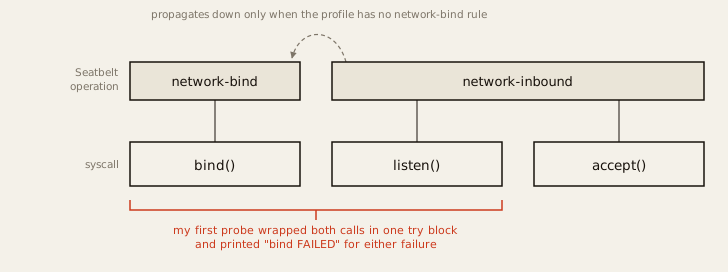
Three syscalls, two operations, and one bracket covering the pair my probe could not tell apart. Everything I concluded from that table came from reading a listen() denial as a bind() denial.
The reason a profile with no network-bind rule can still bind is that network-bind sits underneath network-inbound in Seatbelt’s operation hierarchy. A rule written on network-inbound propagates down to network-bind when the profile has no network-bind rule of its own. That inheritance produced row three of my table, the inbound-only profile that printed bind ok with no bind rule written anywhere in it. I read that row as proof that network-bind was doing nothing. It was the inbound rule standing in for a bind rule that was not there.
Precedence is by specificity rather than by position, which is worth knowing separately because Seatbelt is usually described as last-rule-wins:
(deny network-bind)(allow network-inbound)   -> BIND_FAIL
(allow network-inbound)(deny network-bind)   -> BIND_FAIL
Same outcome either way. The rule naming the more specific operation wins no matter where it sits.
Apple’s own profiles use the split exactly this way. From /System/Library/Sandbox/Profiles/com.apple.rpcbind.sb:
;; Allow binding on our ticotsord transport
(allow network-bind (literal "/private/var/run/rpcb.ticotsord"))
;; Allow receiving on our ticotsord transport
(allow network-inbound (literal "/var/run/rpcb.ticotsord") (local tcp) (remote tcp))
One socket, two rules. The bind rule names the transport and nothing else. The inbound rule covers that same socket and adds (local tcp) (remote tcp), because receiving is a separate authorization that takes its own filters. If one operation covered both syscalls, the second rule would be redundant, and Apple would not have written it.
The kernel had been logging the answer
Both denials arrive in Python as the same object. PermissionError(1, 'Operation not permitted') is what you get for a refused bind() and for a refused listen(), and the exception carries nothing else to tell them apart. That is the layer I was reading, and it is the wrong layer. One level down, the kernel writes the name of the operation it refused to the unified log, every time.
Two profiles, the first allowing network-bind alone and the second allowing network-inbound while denying network-bind:
$ sandbox-exec -f bindonly.sb python3 split.py 127.0.0.1 57111
BIND_OK  LISTEN_FAIL PermissionError(1, 'Operation not permitted')

$ sandbox-exec -f denybind.sb python3 split.py 127.0.0.1 57112
BIND_FAIL           PermissionError(1, 'Operation not permitted')

$ log show --last 25s --predicate 'eventMessage CONTAINS "deny(1) network"' --style compact
kernel (Sandbox) Sandbox: Python(80245) deny(1) network-inbound local:*:57111
kernel (Sandbox) Sandbox: Python(80246) deny(1) network-bind    local:*:57112
Identical errors in Python, and the log separates them by operation name and prints the filter it evaluated. It needs no privileges, no modification to the profile, and no change to the program under test. Run against row one of my table, it would have printed network-inbound beside a probe whose own output said bind FAILED, and three days would have ended that afternoon.
One thing to know before leaning on it. The kernel collapses identical denial messages, so five refused listen() calls on the same port from one process produce a single log line, and a loop that fails on every iteration reads as though it failed once. Vary the port if you want to count them.
Under the pair of rules I ended up shipping, that same predicate stays silent through a full bind, listen, accept, and poll on loopback, and prints exactly one line for a dial to 1.1.1.1: deny(1) network-outbound remote:*:80.
The two rules you need
Two rules are enough to serve and poll on loopback:
(allow network-inbound (local ip "localhost:*"))
(allow network-outbound (remote ip "localhost:*"))
The outbound rule is separately required. Without it the server comes up and nothing can talk to it, including the process that started it:
step 1 bind/listen ok on 127.0.0.1:50580
step 2 accept+poll FAILED -> URLError(PermissionError(1, 'Operation not permitted'))
Remote egress stays denied under all of these, which I checked with a raw dial to a literal IP rather than a hostname, since a hostname failure could be DNS and tells you nothing about which rule refused:
raw TCP 1.1.1.1:80 -> refused: PermissionError(1, 'Operation not permitted')Both rules lean on the localhost token, which does not mean what it looks like.
The filter is stranger than it looks
(local ip "localhost:*") is not an address match. The host component accepts two tokens and the compiler rejects everything else:
$ sandbox-exec -f bogus.sb python3 split.py 127.0.0.1 57999
sandbox-exec: host must be * or localhost in network address
localhost here means “an address belonging to this machine” rather than 127.0.0.0/8. Under an inbound rule naming localhost, a process can bind 0.0.0.0 and the machine’s LAN address, because those are addresses this host owns. The filter is doing its job. For inbound it is simply vacuous, since every address you can bind belongs to this host.
The same token genuinely constrains outbound, where the distinction is observable:
-> 192.168.50.1:80    EPERM          (the router, a different host)
-> 192.168.50.205:9   ECONNREFUSED   (this host's LAN address, permitted)
-> 1.1.1.1:80         EPERM
The port component does filter on both. Under (allow network-inbound (local ip "localhost:12345")), binding 12345 works and binding 12346 returns EPERM.
A demo I should not have trusted either
Having found that a sandboxed process can bind 0.0.0.0, I curled its LAN address from outside the sandbox, got a response, and was ready to write that a sandboxed command can publish a service to everyone on your network.
$ route get 192.168.50.205
   route to: mac
  interface: lo0
Traffic to my own LAN address never leaves the machine. My curl went over loopback, and so did every other client I could produce locally. A wildcard listener with the application firewall off is a real reason to expect LAN exposure, and netstat shows tcp4 *.40030 LISTEN. I haven’t demonstrated it. Settling it needs a second machine, which is a test I have not run.
If you are copying these rules
The (allow network-bind (local ip "*:*")) line that looks inert is the rule authorizing the bind. Deleting it is safe only when the profile has no other bind rule, because inbound then propagates down and brings its own filter with it, including the port constraint. In a profile carrying an explicit (deny network-bind) or a narrower inbound filter, removing that line breaks the server.
The comment I wrote above those lines claims three things: that network-bind does not match a localhost:* filter, that it silently refuses the bind, and that all three rules are needed. So I rebuilt the profile as it stood before that commit and added the three edits back one at a time, against a probe that binds, listens, accepts a connection, and polls itself:
bind localhost:*                        BIND_OK  LISTEN_FAIL
bind localhost:* + inbound              BIND_OK  LISTEN_OK   POLL_FAIL
bind localhost:* + inbound + outbound   BIND_OK  LISTEN_OK   POLL_OK
bind *:*         + inbound + outbound   BIND_OK  LISTEN_OK   POLL_OK
The filter I called broken matched the bind in every row, including the first, where no other rule in the profile could have authorized it. The inbound rule and the outbound rule each cleared a real failure. The last two rows are identical, so widening from localhost:* to *:* bought me nothing, and the comment explaining why I had done it was explaining a change that did nothing. Four runs, and I could have had them before I wrote a word of it. The comment comes out.
Two things that cost me time
Use a fresh port on every run. A port in TIME_WAIT from a previous successful run reports Address already in use, and when you already suspect your policy that reads exactly like a denial.
Do not let two syscalls share a try block when you are working out which one the kernel refused. I had a table, the table had real numbers in it, and it was measuring something other than what its column header said. Three days and a source comment came out of that. Both of my wrong answers survived every test I thought to run, because I designed those tests while believing the thing they were supposed to check. Neither survived twenty minutes of trying to break them on purpose.
All results are macOS 15.7.3, build 24G419, Darwin 24.6.0. None of this is documented or promised, so pin your own results to a version and re-check after upgrades.